 |
| Bacillus anthracis @lanl.gov |
We're learning about pathogens in microbiology right now and we looked specifically at genus that forms spores:
Bacillus and
Clostridium. The most well-known specie of
Bacillus is
Bacillus anthracis, the causative agent of anthrax. Spores are very resistant forms of microbes that can stay dormant for a long time without the need of nutrients, energy, or anything else that is required for living organisms. In fact, usually cattle that are infected with the pathogen are incinerated to prevent the spores from remaining in the soil.
 |
| Bacillus anthracis spore @ cdc.gov |
My microbio professor told us the story of Gruinard Island, located off the coast of northwestern Scotland. During WWII, the British did biological warfare tests on that tiny island. Sheep were put on the island, along with some Bacillus anthracis. Naturally, the sheep all died. And well...the researchers were left with an island infested with a deadly pathogen that forms spores and doesn't die, but live basically forever in the soil. So what did they do during that time? They quarantined the island and prohibited anyone from going there.
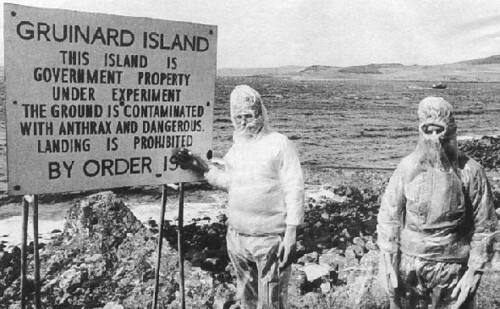
In the 80s, environmental protest groups forced the British government to take responsibility and clean up the island. The protest group got soil samples from Gruinard and threatened to release the samples to the public if the government continue to leave the island contaminated. The government quickly began their clean up of Gruinard. They poured lime in the soil, remove the most hazard portions, and poured formalin into the waters that surround the island.
 |
| Gruinard Island@lonely-isles.com |
There are three types of anthrax: cutaneous, gastrointestinal (GI), and pulmonary (inhalation). Cutaneous, though looks the worse, is the one that is more easily treated relative to gastrointestinal and pulmonary. Cutaneous anthrax causes eschars, which are black legions on the skin (it looks like a huge black scab). Cutaneous type is usually not fatal, unless the pathogen gets through the skin and into the blood. GI and pulmonary types have high fatality and characteristic symptoms include dysentery and hemorrhaging, respectively. Personally, I see Gruinard Island as an Azkaban-like place from Harry Potter...it's easier for me to remember things if I connect it to something else. It seemed like something wizards would try to do to prevent Muggles from accidentally coming upon the island. Not to mention blogging this really helps me study for microbio =]

No comments:
Post a Comment